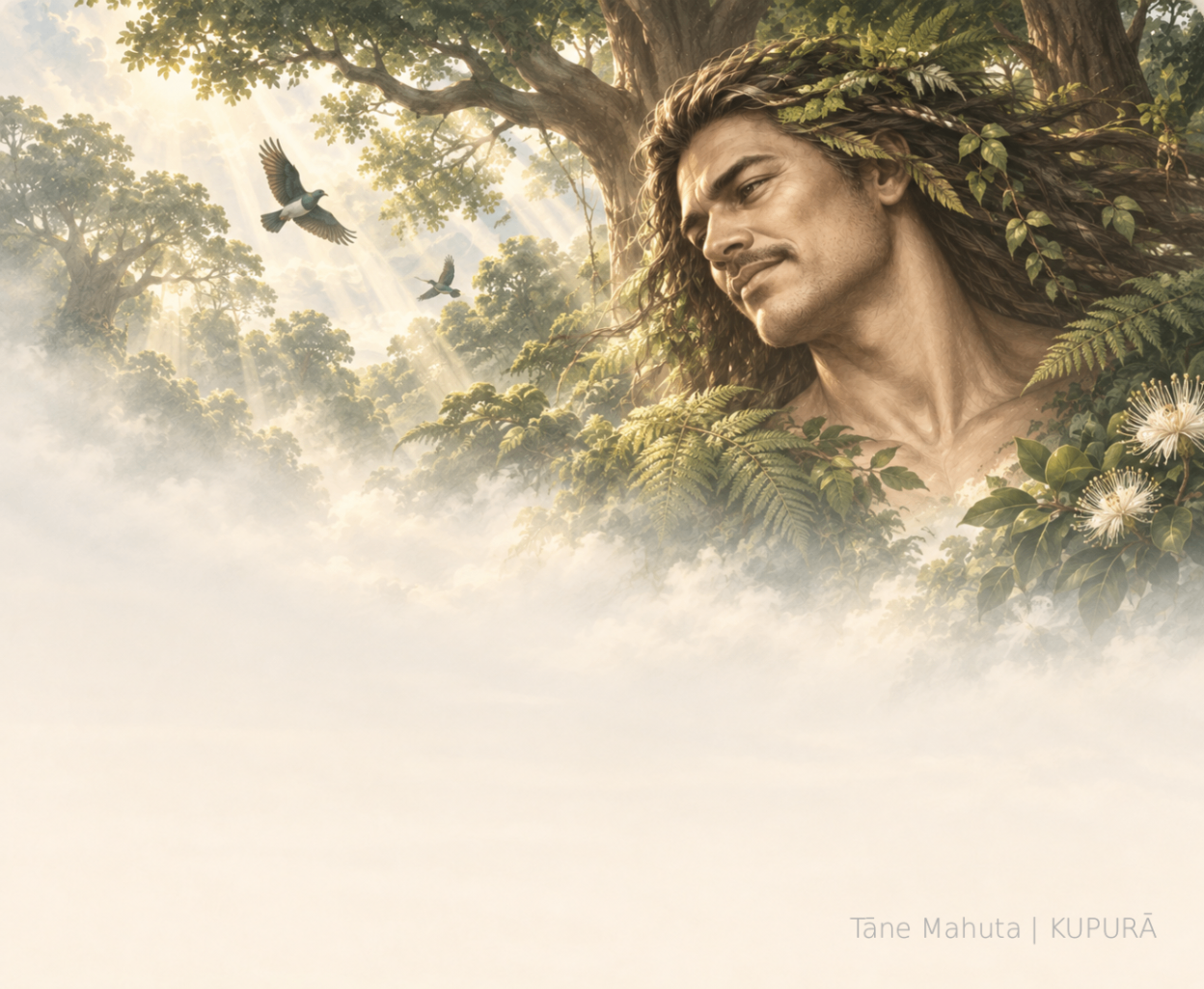
Te wao nui, ngā manu, te ira tangata (Forests, birds, and the origin of people)
Say it: TAH-neh MAH-hoo-tah · Tāne = man; Mahuta = to spring up, to grow.
Tāne separated Ranginui and Papatūānuku so that light could enter the world. He is the one who reaches — growth, knowledge, and the courage to stand upright.
Te Kāwai (Line of descent)
Te Kore → Te Pō → Papatūānuku → Tāne Mahuta
Te Kōrero (the story)
The one who pushed his parents apart so light could come in — the first act of courage in the world. He made the forests, the birds, and shaped the first human from earth.
Te Whakapapa (the genealogy)
Son of Ranginui and Papatūānuku; the one who separated them.
Brother of Tangaroa, Tāwhirimātea, Tū, Rongo, Haumia and Rūaumoko.
Father of the trees, the birds and the insects — the hakuturi who corrected Rātā.
Shaped Hineahuone from the soil at Kurawaka; father of Hine-tītama, who became Hine-nui-te-pō.
Ngā Mana (domains and influence)
Kei Kōnei Rātou (they are present here)
Ngā Huarahi Hono (ways to connect)
At the start of a hike or bush track
Stop at the trailhead before your first step. Say 'kia ora Tāne, he manuhiri ahau' — I'm a visitor here. Leave a small koha at the entrance: a stone placed deliberately, a few drops of water poured out, or a leaf set at the base of a tree. Nothing plastic, nothing you'd need to pick up again.
Walking through the bush
Greet him as you go — a quiet 'kia ora' at a big tree is normal, not strange. You're in someone's house.
Leaving the track
Turn back at the edge of the bush and say thank you. Take out more than you brought in.
Before pruning, felling or picking
Say what you are taking and why. Rātā learned this the hard way.
If you are new to this
Before you cut, prune or pick anything growing, pause and say why you are taking it.
A Common Misunderstanding
He isn't 'the god of trees' in a decorative sense. Trees are his descendants — which is why timber, firewood and even paper are treated as taonga with an origin.
Ngā Taha o te Ora (aspects of life)
Ngā Uara (values)
Whakapapa · Genealogy and lineage
Everything is related; you descend from forest and sky.
Mātauranga · Knowledge
Knowledge is carried, not owned.
Kaitiakitanga · Guardianship
Guardianship of what grows.
Ngā Pūrākau (the traditional stories)
Told in full, the way they would be shared out loud. Versions differ between iwi (tribe), hapū (sub-tribe) and whānau (family).
Ngā kete o te wānanga — the baskets of knowledge
The climb to the highest heaven, and what Tāne brought back down for us.
About 4 min read
Hine-ahu-one — the woman shaped from earth
How the first human was made, and the long search that came before it.
About 3 min read