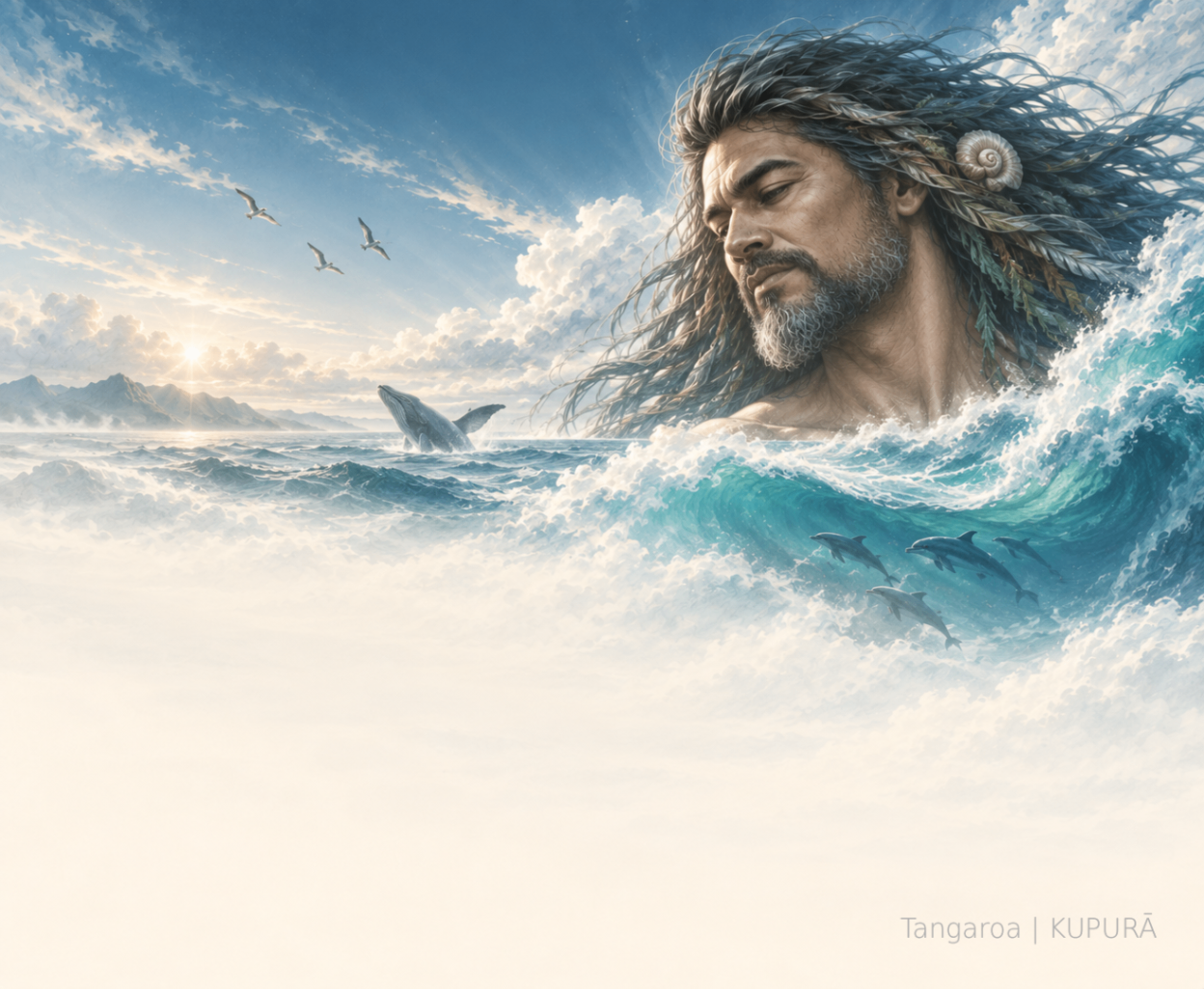
Te moana, ngā awa, ngā ika (The sea, rivers, and all that lives in water)
Say it: tah-nga-RO-ah · Often read as 'tanga' (to spread) + 'roa' (long) — the long expanse.
Tangaroa moves in tides. He teaches that everything arrives and departs, and that abundance follows respect.
Te Kāwai (Line of descent)
Te Kore → Te Pō → Papatūānuku → Tangaroa
Te Kōrero (the story)
The sea and everything living in it. His breathing is the tide, which is why fishing and planting were timed to the moon rather than the clock.
Te Whakapapa (the genealogy)
Son of Ranginui and Papatūānuku; brother of Tāne, with whom he has an old quarrel.
Father of Punga, and through him the fish and the reptiles.
Kin to Hinemoana, the ocean's surface, and to Tinirau who keeps the fish.
All fresh water eventually returns to him — the awa are his relatives, not separate.
Ngā Mana (domains and influence)
Kei Kōnei Rātou (they are present here)
Ngā Huarahi Hono (ways to connect)
Entering the water
Wet your hands and touch water to your head before you swim. It is a greeting and a request.
Taking kaimoana
Say aloud what you're taking and for whom, then stop at that number.
Turning on a tap
Once a day, notice it. Drink the glass slowly. It is his water passing through your house.
Leaving the beach or river
Face the water, say thank you, and don't leave with anything living in your pocket.
If you are new to this
Drink a glass of water slowly and treat it as something given rather than bought.
A Common Misunderstanding
Rāhui (a temporary ban on taking food from a place) is not superstition — it is fisheries management with a spiritual seal on it.
Ngā Taha o te Ora (aspects of life)
Ngā Uara (values)
Manaakitanga · Care and hospitality
Take only what you can share.
Tapu me noa · Sacred and unrestricted
Some places and times are set apart.
Rāhui · Temporary restriction
Rest lets abundance return.
Ngā Pūrākau (the traditional stories)
Told in full, the way they would be shared out loud. Versions differ between iwi (tribe), hapū (sub-tribe) and whānau (family).
Te riri o Tangaroa — the sea and his brother
Why the tide chews at the shore, and why fish and lizards are cousins.
About 4 min read
Te Moana-nui-a-Kiwa — the ocean that was a road
How the largest ocean on earth became a highway, not a barrier.
About 4 min read